
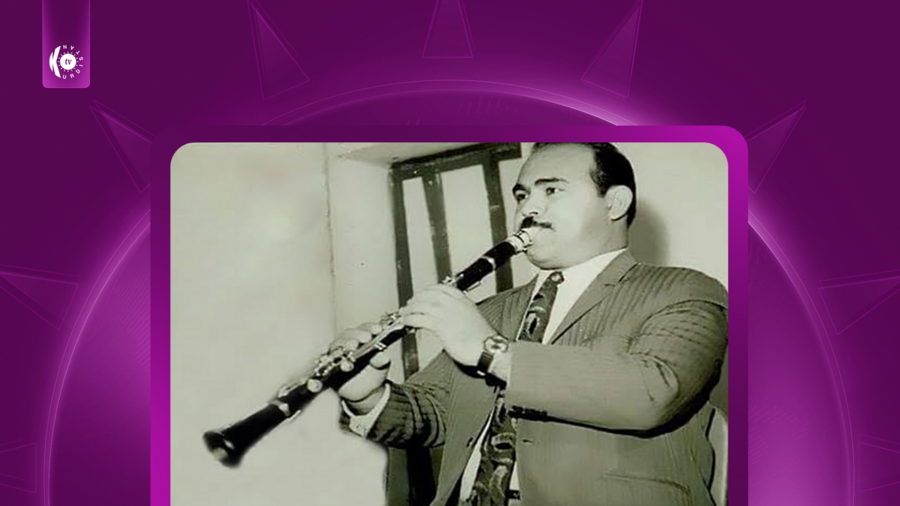
Artist Shawkat Rashid (1930 – 17/4/1991)
Musician, composer, singer and witty speaker..!
The artist who remained in the service of the art of music and song until his last breath!
Very rare are those personalities who devote their entire lives to their people; they continually burn like candles, providing light to those around them while depriving themselves of it. Artist Shawkat Rashid was one of those multifaceted artists who was devoted, compassionate, always self-sacrificing and tirelessly served the path that is Kurdish music and song. Until the final moments of his life, he was an indefatigable and dedicated traveler on the path of art, as a musician, singer, teacher, composer, arranger and music distributor.
Artistic life
The artistic life of artist Shawkat Rashid was overflowing with artistic work, service, teaching and artistic contribution in the cities of Kirkuk, Sulaymaniyah and Koya. Although the artist himself proved his existence through his abilities and artistic works, his artistic name and personality will remain sacred in our memory and in the realm of music and song.
Malkandi Quarter
It is one of the old quarters of the city of Sulaymaniyah and the birthplace of artists Shawkat Rashid, Osman Ali and Hama-i Nargiz; it is also the place where the artist and teacher Anwar Qaradakhi grew up and developed in the field of art.
The artist (Shawkat Rashid Izzat Abdullah Hamza Agha of Baban), from a poor, art-loving family consisting of (seven sisters and four brothers), was born in the Malkandi neighborhood in (1930). He was the eldest brother of his brothers, named (Salah, Anwar, Fuad, and Azad).
Why do I call it an art-loving family? Because his father, (Rashid Izzat), was a government employee and also had artistic talent; he was a good and capable flute player and had a beautiful yellow-colored flute. Whenever he felt inclined and had the taste for it, he played his flute for his children(1).
That artistic feeling and the sweet melody of his father's flute affected both brothers (Shawkat and Salah Rashid). The artist paid close attention to his father's flute playing so that he could train his hands, fingers, and breath-filled chest in playing the flute. Shawkat Rashid began his schooling in the middle of the thirties; he was a cheerful, smiling child, and from that time his vocal ability and talent were recognized. In his classroom and schoolyard, he often sang songs; although at first, because he was shy, it was difficult for him, with the encouragement of his teachers and friends he overcame his shyness and sang hymns and songs for the students and teachers. The artist's education extended only through the sixth grade of primary school, which he completed; afterward, he turned to working and moved away from school and education.
When the artist reaches the age of (18) years, that is, in (1948), he is called up for military service (clearly, at that time military service was compulsory) and sent to the city of Kirkuk. He puts on a military uniform, and on the training ground the soldiers are asked who is literate; the artist is one of the soldiers who is literate. After they are separated, the artist Shawkat Rashid requests to be sent to the military brass and music band because he was interested in and passionate about music. His request is approved, and he becomes one of the members of the military brass and music band and continues training and learning musical instruments such as (clarinet, nay, saxophone, oud, balaban, drum, and cümbüş). Day by day, his artistic ability and talent become more apparent; he becomes an active member of the band, performs his duties passionately, and achieves success, until he attains the rank of supervisor of the military brass and music band. The artist Shawkat Rashid was not selfish; rather, he wanted the training and knowledge he had acquired not to be for himself alone, and enthusiastically sought to teach several people music.
He remains for many years in the city of Kirkuk and delves ever more deeply into the spirit of music, acquiring good expertise in the instruments (clarinet, cümbüş, and oud), and becomes a renowned musician in the cities of Kirkuk and Sulaymaniyah.
He emerges as a skilled musician, and since childhood he had possessed vocal talent. For the purpose of recording songs, he goes to Baghdad Kurdish Radio. The capable writer and presenter (Kamal Raouf Muhammad 17/1/1942 – 30/9/2018) refers to the first day of recording a song on the radio and says: «For the first time, on Saturday (1/2/1958), he broadcast a song on Baghdad Kurdish Radio». According to the information written by the teacher and artist (Bakuri 5/11/1928 – 2/11/2022), he says: «The first song was called (Your darkened eyes make the heart fly), and later, after 14 of July 1958, he appeared at the celebrations in Sulaymaniyah, Kirkuk, and Baghdad as a clarinet player and singer»(2).
While the artist was in the military brass and music band and training on musical instruments, at the same time he strengthened his education until he decided to take the external examination. The teacher, artist, and writer Bakuri wrote: «His artistic intelligence and agility, both within the framework of the Kirkuk military brass band and in the musical bands in which he participated, led to his acceptance by the administration of the Institute of Fine Arts in Baghdad, so that Shawkat Rashid could take the ministerial examination as an (external student). He took the examination and received his certificate with distinction (merit) in (1967 – 1968)»(3).
In the same year that he obtains his certificate, that is, (1968), the artist goes to Kirkuk Television and records his first song, called (Kali Hay Limo).
The Kurdish Art and Literature Society – Sulaymaniyah General Center, was established in (1969) and was granted its operating license on (31/12/1969) by the Interior Ministry of that time. The society aimed to raise the scientific level of artists and bring those gifted in art and literature closer together, with the purpose of serving authentic art and literature in particular and global art in general. It consisted of four main sections: (the song, music and dance section; the acting section; the literature section; the visual arts section).
Artist Shawkat Rashid was one of the founders and an active member of the Kurdish Art and Literature Society. This group presented many works on stage and on television. The members of the song, music and dance section were: (Shawkat Rashid, Namdar Qaradakhi, Salah Rashid, Ali Hama-Raza, Hama-Saeed Abdullah, Sherko Adel, Hoshyar Kamal). The singers of the aforementioned group included the artists: (Osman Ali 1944 – 21/6/2005), (Hama Nergez 1944 – 23/9/2013), (Salah Majid 8/3/1951), (Ibrahim Saeed, known as Bley Sa'a Karr 1942 – 1/9/2010), and others.
Regarding the beginnings of the Kurdish Art and Literature Society and the spirit of cooperation that artist Shawkat Rashid had toward those around him, teacher and artist (Namdar Qaradakhi, 1951 Halabja) says:
“The head of the group was the late artist (Ahmed Dang Gewre, 6/6/1930 – 22/12/2004). The group's management team consisted of (Nouri Washti, 1935 – 12/5/2001), (Taha Khalil, 1940 – 17/11/2010), Nawzad Majid, Shawkat Rashid, (Jalal Kocher, 1943 – 3/3/1993), and others. Later, some of them left; for example, the late artist Shawkat Rashid, who was employed in a musical ensemble in Kirkuk and had two wives (one household in Sulaymaniyah and another in Kirkuk), could not remain with us until the end. But I must never forget that the artists in general, and the late Shawkat Rashid in particular, welcomed me very warmly, made me feel at home, and encouraged me; they made a place for me in the band and supported me. Apart from his artistic support, Kak Shawkat also helped me spiritually: I knew so little, yet they included me in the band. I always say that I am indebted to him. As a young man, I went into the group's room and said that I wanted to become a member. At that time, Kak Shawkat was the head of the band. With his warm welcome, friendly smile, and kind manner, he put me at ease and overcame my shyness, saying: ‘Take out your violin and join us!’ His behavior encouraged me even more to continue” (4).
Artist Shawkat Rashid, as a composer, instrumentalist, singer, musicologist, and music-notational expert, advanced along the sacred path of art and rendered an unparalleled service to the music and songs of his people. He composed melodies for many artists, such as: (Ibrahim Khayat, Osman Ali, Hama Nergez, Salah Rashid, Salah Majid, Hama Jaza, and Kamanan Omar). He concentrated his artistic work as an instrumentalist, singer, arranger, and music distributor in several musical troupes; he was an honored member of the music troupe of the Kurdish Art and Literature Society, the Bekas music troupe, and the Solav music troupe in the city of Kirkuk, as well as the Bawaji troupe of Koya.
Artist Shawkat Rashid and the Solav music troupe...
Because of the reputation he had established as a capable instrumentalist, and at the same time because of his work in the city of Kirkuk, the artist developed friendship and companionship with the artists of that city. In (1958), the (Bekas music troupe) was established in the city of Kirkuk; for a period, artist Shawkat Rashid became a member of the aforementioned troupe, and later became a member of the Solav music troupe. One of the artist’s old friends, instrumentalist and poet (Ramazan Zามdar), says:
“Artist Shawkat Rashid came to our troupe in 1964, and I immediately made him a member of the Solav music troupe. In addition to Shawkat Rashid and me, these artists were also with us: (Abdulillah Muhyiddin, Salah Serraj, Sardar Fattah, Salah Rashid, Anwar Tahir Koyi, Hama-Raza, and Qadir Mardan). Later, Shawkat Rashid became the troupe’s president. The artist cooperated and participated in the activities of the musical troupes of the cities of Erbil, Sulaymaniyah, and Koya, and he was also an active member of the Kirkuk television music troupe.”(5)
Besides his talent and ability to play musical instruments and his beautiful voice, the artist was one of those talkative, humorous, good-natured and convivial personalities among his friends, companions and associates. These qualities made everyone love him and always look upon Shawkat Rashid with respect and esteem. In the year 1967, he took part as a musician in several private gatherings of the immortal artist Hassan Zirak in the city of Sulaymaniyah, alongside artists such as William Yohanna, Azolay Tapl, Salah Rashidi, his brother, and Hassani Nay; one of those gatherings of the artist Hassan Zirak was held at the home of the artist Shawkat Rashid himself.
We can also present the information that at the beginning of the sixties of the previous century, the two musician brothers, Muhammad and Hasan Mamli, visited the city of Sulaymaniyah; with the cooperation of the musicians Shawkat Rashid, Salah Rashid, William Yuhanna, and Ibrahim Khayyat, they recorded a cassette for the musician Muhammad Mamli at the home of Gharibah Qalaw.
Following the 11 statement of Adar 1970, a favorable climate for the world of literature and art emerges, and artistic activity (singing, music, and theater) begins to flourish. The artist Shawkat Rashid, as a skilled, active, and energetic musician, performs several celebrations together with the artists of the Bawaji team of Koya in the cities of Koya and Sulaymaniyah; including the celebration of the national festival of Newroz (1970) at the Sulaymaniyah Employees Club, as well as on the date (19 / 7 / 1970) at the Koya Employees Club.
The Kurdish Association of Art and Literature – Sulaymaniyah General Branch invites some of the artists of the Bawaji Koya music ensemble to the city of Sulaymaniyah. At the Sulaymaniyah Girls’ Preparatory Hall, for a period of 10 ten days, from 13/9/1970, artists from the Kurdish Association of Art and Literature and Bawaji will perform. The artist Shawkat Rashid was one of the distinguished members among the musical ensembles, alongside the artists Namdar Qaradakhi, Jan Thomas Jano, Zahir Muhammad, Anwar Tahir (“Mulla Anwar”), Warya Ahmad, Sardar Ahmad, Harut Balangian, and Salah Rashid.
In the mid-seventies, through the efforts and dedication of the artist Shawkat Rashid and several musicians from Kirkuk, they established a music ensemble named the Kirkuk Television Music Ensemble. Shawkat Rashid supervised the ensemble and, through it, gave extensive support to artists who recorded their artistic work for television.
Under the supervision of artist Shawkat Rashid, they will present a music and singing concert at Sulaymaniyah City Stadium on the occasion of (World Children's Day) in the year (1971).
On (25/2/1974), the artists of the Kurdish Arts and Literature Society – the General Branch of Sulaymaniyah, will present the opera (The Bride and Groom) at the Khuld Hall in the city of Baghdad, directed by the artist Taha Khalil, with music by the two artists Shawkat Rashid and Hoshyar Ahmad, known as Wisha Baba. At that festival, they will win first place at the level of Iraq.
The artist Shawkat Rashid is considered the second instrumentalist and the best and most skilled clarinet player in Southern Kurdistan after the artist Qadir Dilan 1928 Sulaymaniyah – 18/3/1999 Czech; he added a quarter tone to his clarinet and transformed it from Western playing into Eastern playing.
Alongside all those artistic talents, he possessed another talent: singing, and was the owner of several songs, such as: (Your Dark Eyes Enchant the Heart, Dark-Eyed Girl, Lemon, I Have Been Waiting for a Long Time, Oh, for the Sake of Sharazay, It Is the Festival, the Festival of Joy, How Beautiful, Who Says You Repent at the Tavern, Aye and Oyiya, May I Be Sacrificed for Your Dark Eyes, the Newroz Anthem, and the Immortal Barzani Anthem). He also had vocal-recognition ability; he drew people with his melodious and pleasant voice, leading them to take a step into the artistic world of music and song.
In the year 1983, on Kirkuk Television, artist Shawkat Rashid hosted a program he prepared and presented himself, called “Arzumenan.” Through this program, he invited young Kurdish singers to not conceal their vocal talents and artistic abilities, but to display them and serve their nation’s art. The artist spoke with those young men and women in a friendly manner and encouraged them further. At that time, Arzumenan was one of the most engaging and enjoyable programs on Kirkuk Television; while viewers derived considerable pleasure from the singing artistry of those talented performers, Shawkat Rashid’s witty conversation and genial manner were an even greater reason for attracting the program’s viewers.
However much may be written about the life of this immortal and devoted artist, it is still not enough, because he devoted his entire life to the genuine art of his nation. After searching and delving into that life, overflowing with the artistic contributions of the artist Shawkat Rashid and his unwavering devotion to his nation’s art, he was always concerned with advancing his people’s art and wanted Kurdish young men and women to learn musical instruments. Through Facebook, I came across a recollection by the artist’s brother, Kurdish Sabir, who says:
“The artist Shawkat Rashid was involved in a traffic accident in 1978; he walked with a cane. Despite that unstable health condition, he came to the city of Sulaymaniyah and, through his own efforts and hard work, formed an instrumental wind music ensemble consisting of 22 members.” This demonstrates that even in the most difficult of health conditions, this artist remained concerned about the art and artists of his nation.
In the year (1984), two songs were broadcast via Kirkuk Television, quickly becoming the subject of much discussion, attracting people’s attention, and becoming songs frequently sung by listeners and audiences: the song (Peyman – We Are One Soul), with lyrics by (Reza Hama the Poet) and music by the artist (Ibrahim Khayat 1931 – 3/5/2005), and the song (The Springtime of My Life), with lyrics by (Sheikh Hasib Qaradakhi 1929 – 9/1/1997) and music by the artist (Salah Rashid 1942 Halabja – 13/3/2026 Canada). After several years, these two songs have become known as the finest, most expressive, and sweetest melodies and productions of the golden era. Regarding how these two songs were recorded, what was the role of the artist Shawkat Rashid?
Artist Salah Rashidi sings for us:
“It was the year 1984. One day, Kak Shawkat, my brother, telephoned me and said: ‘Bring Kak Ibrahim Khayat as well, and I will obtain your approval for one of my songs.’ Kak Ibrahim and I went to Kirkuk; within a day and a night, Kak Shawkat arranged the music for the song ‘The Spring of My Life,’ while Kak Ibrahim did the song ‘We Are One Soul in Two Bodies.’ The two of us recorded our songs in one day; both of our songs gained great fame throughout Kurdistan, and people were very impressed by them” (6).
With the aim of commemorating and recalling the artistic life of the artist Shawkat Rashid, after searching extensively for sources, I sometimes tried, through telephone calls or social media, to obtain the views and opinions of writers, artists, and poets about that artist, in order to learn what their perspective was. For that purpose, I turned to the sensitive and graceful poet Hama Aziz, who lives in Canada. Regarding the versatile Shawkat Rashid, he said:
“The late artist Kak Shawkat Rashid was a distinguished and innovative performer of the clarinet. Alongside his musicianship, he was also a composer and singer. Throughout his artistic career, he had a devoted passion and a pure love for contributing to the development of authenticity and modernization of Kurdish song in the era in which Kak Shawkat lived. This artist deserves far more recognition and respect; however, sadly, like hundreds of lost soldiers in the fields of literature and art, his name, memory, and high artistic standing have faded and been buried beneath the dust of neglect and oblivion.” 7
Teacher and artist Namdar Qaradakhi, having lived with his teacher and worked together on artistic projects for a long time, speaks about several other qualities of the artist Shawkat Rashid:
“Uncle Shawkat Rashid has a distinguished history in many artistic and social respects. He was a talented musician; he was one of the most capable clarinet players. In addition to the clarinet, he also tried to learn the oud, jumbush, and several other instruments. Besides being a musician, he was also a good composer; all the songs he performed were his own compositions, and he also composed many pieces for other artists. In addition to all this, he was a good and capable music arranger; apart from these qualities, he was also a good supervisor. He was also the founder of several musical groups, such as the Kurdish Arts and Literature Ensemble, the Sulav Music Group in the sixties, of which he was an active member, and he was also the founder of the Kirkuk Television Music Group; no matter how much we talk about him, it is still not enough.” 8
As we mentioned, the artist was a cheerful, sociable, witty, and good-humored person. I would like to write down one of the anecdotes and amusing stories of the artist Shawkat Rashid, which Usta (Hewai Madhati Kebabchi) recounted on Askan Canal Street:
“May the memory of the artist Shawkat Rashid be blessed. He often used to come to my place to eat kebab. One day he came by and ordered kebab, and I said: ‘Brother Shawkat, shall I add garlic to your kebab?’ With a cheerful, smiling face, he replied: ‘I play the zurna, so mix it in for me, so I can eat garlic and play the zurna!’”
Artist Shawkat Rashidi retired in (1989) after serving for many years, but his heart and mind remained devoted to serving the art of music and song.
In his social life, the artist married twice; he had one home in Kirkuk and another in the city of Sulaymaniyah. In 1957, he married Lady Sadiqa Muḥyiddin, and in 1960, Lady Misriya Ahmad Abdullah. From his first marriage, they had four sons and one daughter, named Saman, Sarwat, Soran, Sartip and Sozan; from his second marriage, three sons and four daughters, named Samal, Sarwa, Solav, Sirwan, Marivan, Suznak and Sara 9.
With great sadness, artist Shawkat Rashid suffered a stroke in August (1990), and the pain from his illness is worsening day by day.
The longtime friend of the artist, broadcaster, and veteran Kirkuk television presenter, Hashim Jabari, says:
"My friendship with the artist Shawkat Rashid goes back to the beginning of the year 1971; our friendship became so strong that it extended to family outings, and together we made several trips and excursions to Baghdad, Hilla, Sulaymaniyah, Erbil, Shaqlawa, and so on. Through him, I came to know many artists. That artist rendered an immeasurable service to Kurdish art and helped establish dozens of artists in the fields of singing and music. At most private celebrations and occasions, he played the clarinet, jumbush, and oud alone and sang. During the uprising (1991), and at the time of liberating the cities and towns of Kurdistan, I, the martyr Asaad Sheikh Bazaini, and the late writer Muhammad Abdulrahman Zangana visited Shawkat, who was ill at the time and walked with a cane; at that moment, news was announced that the town of Makhmur had been liberated, and he said through tears: It is almost time for Kirkuk to be liberated too; death has nearly overtaken me, and I will not see Kirkuk's freedom."
Artist Shawkat Rashid’s health deteriorates, and his sons take him from Kirkuk to Sulaymaniyah for treatment by his specialist doctor, Dr. Fuad Baban. When they reach the entrance to the city of Sulaymaniyah (his birthplace), on the day of 17 4 1991, he bids a final farewell to art, artists, and his friends and companions.
When the artist Shawkat Rashid passes away and that shining star of Kurdish music, melody, and song is extinguished, our people are living through the greatest misery, hardship, and crisis; it is also the mass exodus of the people of Kurdistan, namely the exodus. At that time, the artist is laid to rest in the Sheikh Muhyiddin Cemetery in the city of Sulaymaniyah, in the sacred soil of Kurdistan. Thousands of bouquets are placed on the sacred grave of the artist Shawkat Rashid, and his sweet memories and remembrance will forever remain elevated, at the pinnacle of their gloriousness.
Sources:
Meeting with artist Salah Rashid ( 11 6 2014 ), composed by Jalal Hanisi.
The History of Baghdad Kurdish Radio (1939 – 1958), written by (Babi Lalo) Kamal Raouf Mohammed, Volume One – Part One, page (660).
The book of immortal singers, Bakuri, Part Two, page ( 199 and 200 ).
Chilawaz magazine, an interview with renowned artist Namdar Qaradakhi, composed by artist Wrya Ahmad, issue (47), February 2010.
“On the anniversary of the passing of the artist Shawkat Rashid,” prepared by: Sattar Jabari, Facebook social network.
Word Site, “Shawkat Rashid... a multifaceted artist in the field of music and song,” Sattar Jabari.
A telephone conversation with the artist and poet (Hama Aziz), Erbil–Canada.
A meeting with the artist (Namdar Qaradakhi), the (Khak) channel, 15 2 2026.
The same source, number ( 3 ), page ( 200 ).