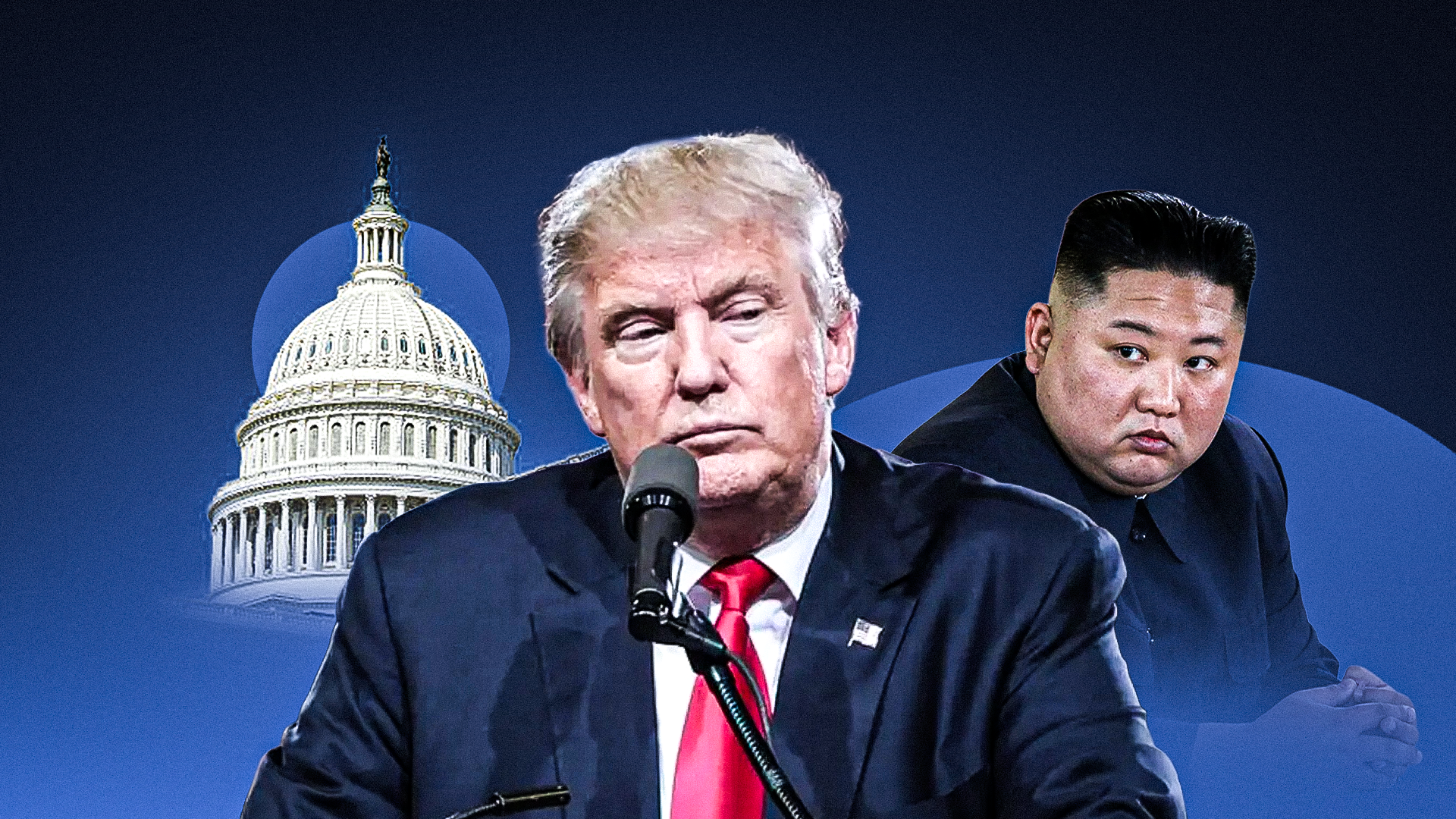
Trump’s focus on North Korea’s leader and his reduction of the scale of joint military exercises between the United States and South Korea had raised concerns among Washington’s Asian allies, particularly amid speculation about efforts to secure a foreign-policy achievement while the war with Iran remains deadlocked.
But Kim Yo Jong, the powerful sister of North Korea’s leader, indicated on Wednesday that Pyongyang was not interested in resuming dialogue with Washington, stressing that her country "has no need to sit face-to-face with people who are so distrustful and hostile."
The North Korean leader’s sister also said: "Clearly, the option of peace includes dialogue, but that does not mean it is in line with our national interests."
The remarks came after the U.S. Federal Bureau of Investigation (FBI) accused North Korea of being behind the theft of nearly $6 billion from the digital currency platform "Binance," allegations previously described as a "dangerous political provocation."
Lim Eul Chul, a professor at Kyungnam University’s Institute for Far Eastern Studies in South Korea, believes Kim Yo Jong’s remarks mark a shift from a defensive position to an offensive one.
Lim Eul Chul told Agence France-Presse: "The latest statement seizes on the issue of (cyberattacks) to condemn the entirety of the U.S. pressure policy toward North Korea."
In 2019, Kim Jong Un returned to his country after a 60-hour train journey from Hanoi without securing any gains, following the collapse of his summit with Trump.
The U.S. president continues to make overtures to Pyongyang, which responds to them coldly.
Lim Eul Chul also said: "For Kim Jong Un, maintaining the status quo is currently the best option."
Analysts say North Korea’s leader has less incentive to meet Trump after the Republican Party suffered a major defeat in the U.S. midterm elections.
Voters handed control of Congress to the Democrats, dealing a major setback to Trump and turning him into a president whose powers will be limited during the remaining two years of his term.
Yang Moo-jin, former president of the University of North Korean Studies in Seoul, predicted that "Trump will continue trying to pursue leader-level direct dialogue with North Korea."
But he said that "political division in Washington and Trump’s position as a weakened president will be two important factors in Pyongyang’s calculations."
For his part, Michael Bosack, founding director of the Vali Institute for Policy and a former United Nations official, believes North Korea doubts Washington’s ability to offer lasting concessions.
Michael Bosack told Agence France-Presse: "The North Korean regime is seeking fundamental and lasting changes in U.S. policy toward it. Trump now cannot guarantee that offers will remain in place beyond January 2029," a reference to the end of his second presidential term.
Pyongyang’s closer ties with Russia and China have also strengthened its negotiating position and reduced its need for talks with the United States.
The Bank of Korea estimated in July that North Korea’s economy grew by more than 3% in 2025, marking its third consecutive year of growth, attributing this primarily to the "expansion of economic cooperation with Russia."
Even if Trump and Kim agree to arrange a meeting, their differences over North Korea’s nuclear program will remain a major obstacle to any diplomatic progress.
Pyongyang has repeatedly stressed that it is no longer willing to discuss giving up its nuclear weapons.
In September, Kim Yo Jong said her country’s status as a nuclear state had become an "absolute" objective, describing those who still hoped for denuclearization as "fools."
This came as South Korean President Lee Jae-myung—known for his conciliatory stance—had proposed that Washington pursue the freezing of North Korea’s nuclear program rather than its immediate elimination, in exchange for easing sanctions.
But that option faces a major obstacle after Trump’s electoral defeat, as Democrats remain committed to the goal of denuclearization and Congress has significant influence over the lifting of sanctions.
Lim Eul Chul said Pyongyang "still has bad memories of the failure of negotiations to achieve progress during the Joe Biden administration, due to the United States’ insistence on offering no sanctions relief or entering dialogue before steps toward denuclearization," and that North Korea’s distrust of Washington, combined with the uncertainty surrounding any potential agreement with Trump, could motivate it to further strengthen its nuclear demands.
He also said: "The belief is becoming increasingly entrenched in North Korea that continuing to independently develop its nuclear arsenal, regardless of changes in U.S. administrations or parties, is a viable and strategic option."
In recent weeks, Pyongyang has carried out a series of tests of new weapons, including a nuclear-powered submarine, attack drones, a precision-guided torpedo system and a medium-range hypersonic missile.
Lim Eul Chul believes that "the development, testing and training involving new weapons will become routine, everyday activities."