
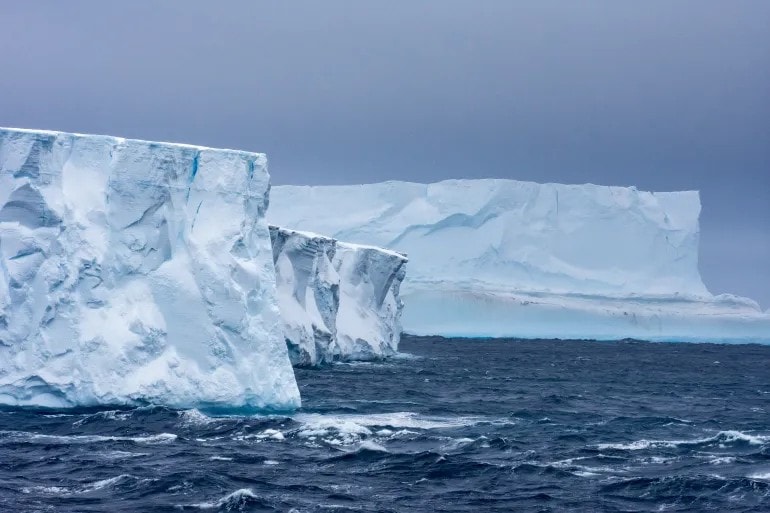
Researchers at the University of California and NASA revealed that the impact of Thwaites Glacier, known as the “Doomsday Glacier,” on rising sea levels is twice as great as predicted and will raise ocean water levels by 30 millimeters by the year 2100.
Researchers at the University of California, Irvine, and NASA’s Jet Propulsion Laboratory have found that the contribution of the largest glacier on Earth, known as the “Doomsday Glacier,” to rising ocean levels will be twice previous estimates. According to Nature Communications, even without any further increase in global temperatures, the glacier’s contribution to rising sea levels will reach 30 millimeters by 2100, while previous predictions were half that amount.
The study stated that data from Finland’s (ICEYE) satellite network over the past 20 years formed the basis of this new prediction. It recorded that warm seawater penetrates several kilometers beneath the glacier’s base and lifts it during high tide, while warm waves accelerate melting at its base.
Thwaites Glacier has become known as the “Doomsday Glacier” because it is the largest glacier on Earth, its width reaches about 120 kilometers, and it accounts for one-third of all ice lost in Antarctica. However, according to Matia Poinelli, a researcher at a NASA laboratory, the “Mugino” mountain range currently prevents the glacier from sliding and collapsing into the ocean, although computer models show a 60 percent probability that the mountain range will collapse by the end of the twenty-first century.
At the end of the report, Eric Rignot, a professor of Earth sciences at the University of California, noted that the new model can fully simulate the glacier’s melting process because it incorporates the most comprehensive methods for physical processes, and that its predictions are twice as accurate and reliable as those of previous models.